Once a year, for a few days, the god who removes obstacles comes to stay. This is why, and how it came to be that way.
No. 019Ganesha Reduced to Circles
I
A guest in the house
once a year, for a day and a half, or five, or ten
Every year, in the month of Bhadrapada, Lord Ganesha comes home. Ganesh Chaturthi celebrates his birth. It falls on the fourth day of the waxing moon, somewhere between late August and the middle of September.
For the days that follow he is not a distant figure in a temple. He is a guest in the house. Families bring a murti home and give him the best place in it. Some keep him for a day and a half, some for five days, some for the full ten. The length is rarely chosen. It is simply what your family has always done.
He is Vighnaharta, the remover of obstacles, and his is the first name spoken at every beginning. He is easy to love: fond of sweets, fond of his small companion the mouse, fond of the people who come to him.
also called
Vinayaka Chaturthi
falls on
Shukla Chaturthi in Bhadrapada, late August to mid September
kept for
a day and a half, or five, seven or ten days
ends with
visarjan; Anant Chaturdashi for the full ten
he brings
buddhi, siddhi, riddhi
II
How it travelled
from home and temple, to the street, to a whole city
Nobody invented Ganesh Chaturthi. The worship is ancient, and even the public celebration is older than the familiar story suggests. What changed, across these years, is how many people it gathered and how far it reached.
long before
An old and deep devotion
Loved and worshipped across India for centuries, in temples and in the daily habit of speaking his name first; celebrated in public in Shivaji's Pune and under the Peshwas long before the modern festival.
1892
The first sarvajanik Ganeshotsav, in Pune
Bhau Rangari installs the first public Ganesha idol, at his wada in Shalukar Bol.
1893
Lokmanya Tilak takes up the idea
And gives it a purpose: a gathering the whole city could share.
early 1900s
The festival arrives in Bombay's mill neighbourhoods
Girangaon, the village of mills: Lalbaug, Parel, Worli and Byculla. The neighbourhood Ganpati gave newcomers a way to belong.
12 september 1934
Lalbaugcha Raja is installed
The story on the next page.
today
Carried forward with care
Shadu clay returning in place of plaster, gentler colours, and a growing tenderness towards the water he returns to.
III
Lalbaugcha Raja
navsacha ganpati, the ganpati of the vow
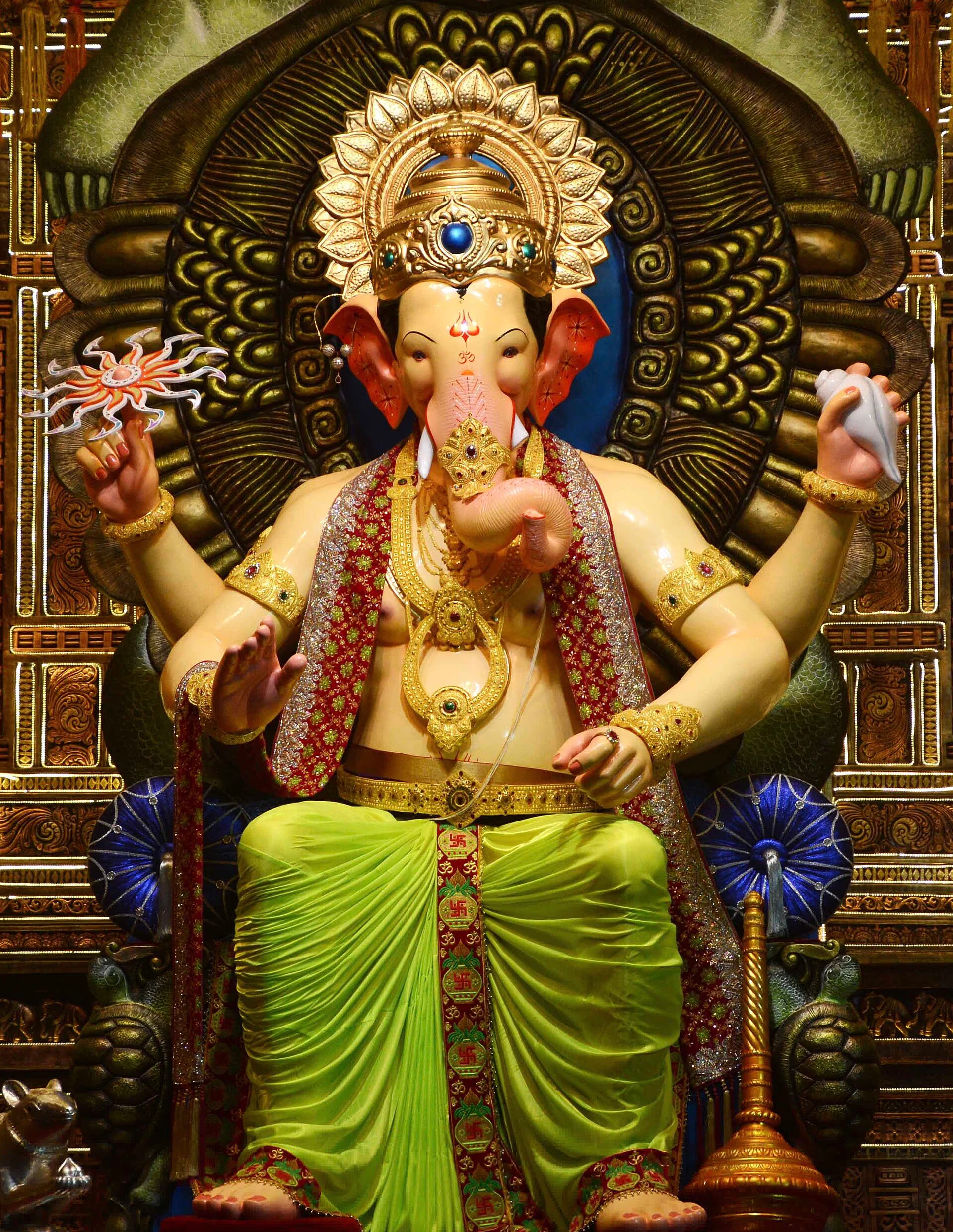
In the early 1930s, Lalbaug was a working neighbourhood in the truest sense: mill hands, Koli fishermen, hawkers and small traders. In 1932 the market at Peru Chawl was closed, and the people who sold there lost the one thing their living depended on, which was simply a place to stand.
As the community tells it, they turned to Ganesha and made a navas, a solemn vow: a permanent place for their market, and an idol in return. The market was built. On 12 September 1934, in gratitude, they installed him. From 1935 the Kambli family took up the making of the idol, and has shaped him ever since.
Two lines form for his darshan. The Navsachi line, for those who come to make a vow or to complete one. And the Mukh Darshan line, for those who come simply to see his face. Many wait through the night. They do not call it waiting.
the prayer that began it was for a place to work
Lalbaugcha Raja · NatePowell · CC BY-SA 4.0
IV
The hundred and eight names
why that number, and what we call him
A japa mala has 108 beads, so a prayer said once on each bead is said 108 times. Tradition counts 108 Upanishads, 27 nakshatras with four padas each, and twelve rashis crossed by nine grahas: every road to the number ends at the same place. It is the count of completeness, the number you reach when you have gone all the way round.
So when his names are gathered into a hymn, an ashtottara shatanamavali, there are 108 of them, and there are 108 drawings in this book. These are the names, in the order they are usually recited, each with what it means.
001Akhurathawhose chariot is drawn by the mouse
002Alampatathe ever eternal
003Amitbeyond compare
004Anantachidrupamayaminfinite consciousness, given form
005Avaneeshlord of the whole world
006Avighnathe unobstructed
007Balaganapatithe beloved child
008Bhalchandramoon-crested
009Bheemathe huge
010Bhupatilord of the earth
011Bhuvanpatilord of the worlds
012Buddhinathlord of wisdom
013Buddhipriyagiver of knowledge
014Buddhividhatawho ordains knowledge
015Chaturbhujthe four-armed
016Devadevagod of gods
017Devantakanashakarindestroyer of the demons' end
018Devavratawho accepts every vow
019Devendrashikaprotector of the gods
020Dharmikthe righteous, the giver
021Dhoomravarnathe smoke-hued
022Durjathe invincible
023Dvaimaturawho has two mothers
024Ekaaksharathe single syllable
025Ekadantathe one-tusked
026Ekadrishtathe single-minded
027Eshanputrason of Shiva
028Gadadharawho bears the mace
029Gajakarnathe elephant-eared
030Gajananathe elephant-faced
031Gajananetiwhose face is an elephant's
032Gajavakrawith the elephant's trunk
033Gajavaktrawhose mouth is an elephant's
034Ganadhakshyachief of the ganas
035Ganadhyakshinawho presides over the hosts
036Ganapatilord of the ganas
037Gaurisutason of Gauri
038Guninamaster of all virtues
039Haridrathe golden one
040Herambahis mother's beloved son
041Kapilathe tawny
042Kaveeshamaster of poets
043Kripaluthe merciful
044Krishapingakshathe tawny-eyed
045Krtilord of music
046Kshamakaramthe home of forgiveness
047Kshipraquick to please
048Lambakarnathe long-eared
049Lambodarathe pot-bellied
050Mahabalathe enormously strong
051Mahaganapatithe great lord of the ganas
052Maheshwaramlord of the universe
053Mahodarathe great-bellied
054Mangalamurtiauspiciousness in a form
055Manomaywinner of hearts
056Mrityuanjayaconqueror of death
057Muktidayagiver of liberation
058Mundakaramathe abode of happiness
059Musikvahanawho rides the mouse
060Nadapratithishtawho delights in music
061Namasthetuwho ends every vice
062Nandanason of Shiva, the delight
063Nideeshwaramgiver of treasures
064Omkarathe form of Om
065Pitambaraclothed in yellow
066Pramodalord of all abodes
067Prathameshwarafirst among all
068Purushthe omnipotent person
069Raktathe red-bodied
070Rudrapriyabeloved of Shiva
071Sarvadevatmanwho accepts every offering
072Sarvasiddhantagiver of skill and wisdom
073Sarvatmanthe soul of everything
074Shashivarnamof the moon's complexion
075Shoorpakarnawhose ears are winnowing fans
076Shubanthe all-auspicious
077Shubhagunakananmaster of every virtue
078Shwetaas pure as white
079Siddhidhatagiver of accomplishment
080Siddhipriyagiver of boons
081Siddhivinayakagiver of success
082Skandapurvajaelder brother of Skanda
083Sumukhaof the auspicious face
084Sureshwaramlord of all lords
085Swarooplover of beauty
086Tarunthe ageless
087Uddandanemesis of evil
088Umaputrason of Uma
089Vakratundathe curved-trunked
090Varadavinayakagiver of success
091Varaganapatigiver of boons
092Varapradawho grants wishes
093Veeraganapatithe heroic lord
094Vidyavaridhithe ocean of knowledge
095Vighnahararemover of obstacles
096Vighnarajaking over hindrances
097Vighnarajendrasovereign over obstacles
098Vighnavinashanayadestroyer of every impediment
099Vignahartademolisher of obstacles
100Vigneshwaralord of obstacles
101Vikatthe gigantic
102Vinayakathe remover, the guide
103Vishwamukhamaster of the universe
104Vishwarajaking of the world
105Yagnakayawho accepts the sacrifice
106Yashaskargiver of fame and fortune
107Yashvasinthe beloved, the ever popular
108Yogadhipalord of meditation
V
We bring him home, and we let him go
clay becomes form, form becomes presence, then returns to the water
The murti is carried home through the traffic, held steady on somebody's lap. Then comes pranapratishtha, the invocation: from that moment he is not an image in the room, he is a guest in the house. He is bathed, dressed and garlanded, and offered modak, durva grass and red hibiscus. There is arti in the morning and arti again in the evening. Children tell him things they have not told anyone else.
On the final day there is uttarpuja, a last worship. Then the same hands that carried him in carry him out again, to the water. The clay softens and dissolves and becomes the river once more. Nothing is truly lost.
Ganpati Bappa Morya, pudhchya varshi lavkar ya
o beloved Bappa, come again soon, next year. sung out loud by thousands, feet already in the water.